

Journal: What We’re Currently Exploring
Replacement Dwellings in the Green Belt: Getting the ‘Not Materially Larger’ Test Right
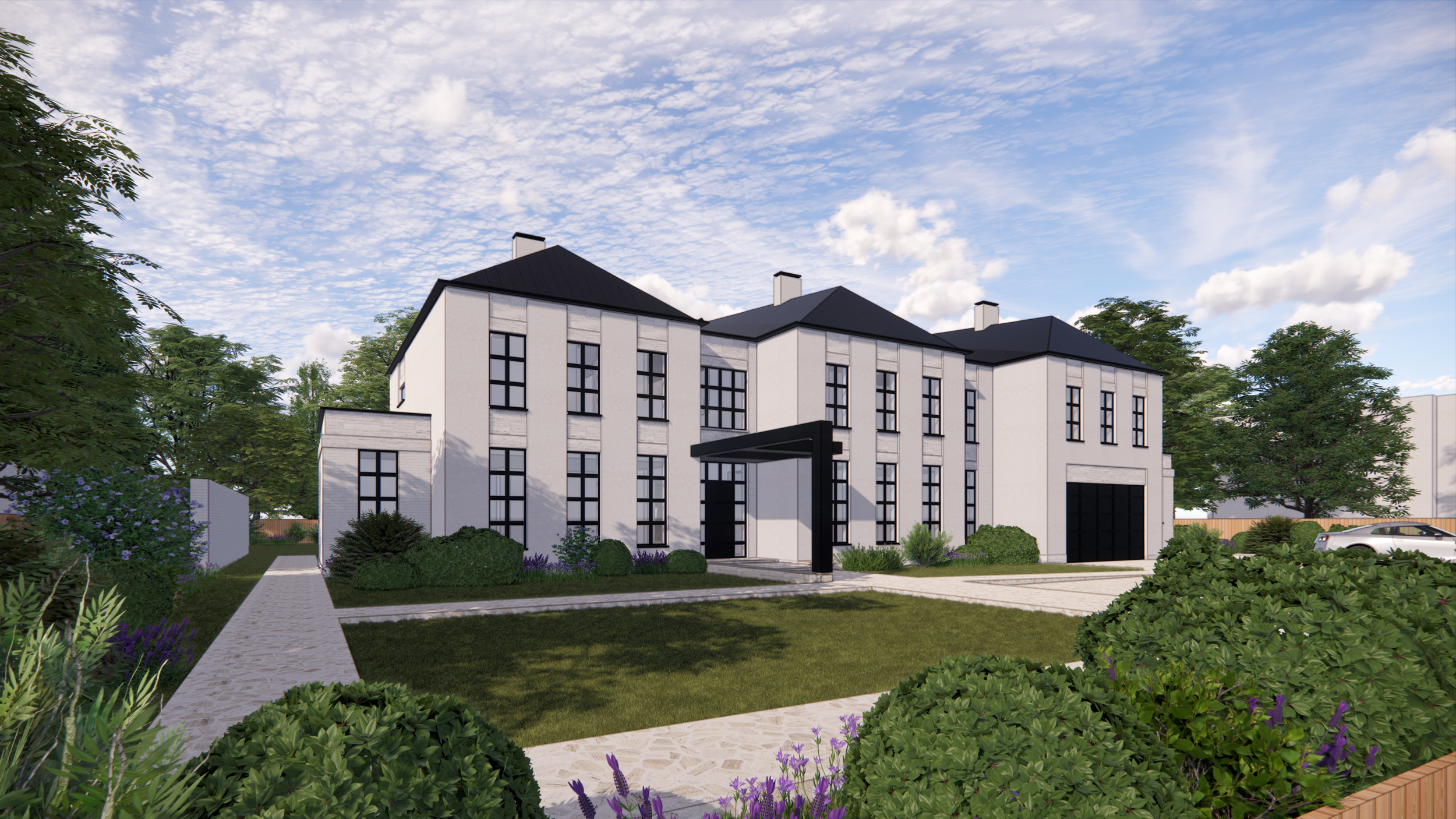
Across Surrey and West Berkshire in particular, a huge proportion of the enquiries we get involve a tired or dated house sitting on a generous Green Belt plot, with clients wanting to knock it down and start again. The instinct is understandable. What's often misunderstood is just how tightly a replacement dwelling in the Green Belt is controlled, and how much hinges on a single planning test.
What Counts as ‘Not Materially Larger’ in the Green Belt?
National planning policy treats the Green Belt as land to be kept permanently open. New homes are, by default, ‘inappropriate development.’ But there's a specific exception for replacement dwellings: a new house can be acceptable in the Green Belt provided it is not materially larger than the one it replaces.
That phrase, "not materially larger," does a lot of work, and it's where most replacement dwelling projects either succeed or stall. There's no fixed national percentage. Local planning authorities each set their own benchmark, often somewhere in the 30–50% increase in volume range, measured against the original dwelling, not whatever extensions and additions have crept in since.
Case Study: A Green Belt Replacement Dwelling Near Elmbridge, Surrey
Our clients owned a mid-century house on a generous Green Belt plot in Elmbridge. The existing house was poorly insulated, awkwardly laid out, and well below the quality the site deserved. They wanted a contemporary two-storey replacement dwelling with considerably more accommodation.
The first job wasn't design, it was forensic. We needed to establish:
The lawful original volume of the dwelling, using historic plans, Ordnance Survey data, and in this case a previous extension that had already used up some of the local authority's allowance.
The local authority's specific Green Belt policy wording and any adopted percentage benchmark for volume increase.
Whether any outbuildings or garages on site could be considered part of the ‘original’ footprint, or whether they would count against any uplift separately.
Once we had a clear, defensible baseline, we could design within it with confidence rather than guessing and hoping. The final scheme increased the volume by a figure comfortably inside the local authority's accepted range, replacing a low, dark bungalow with a light-filled, energy-efficient two-storey home, and consent was granted at committee stage without significant objection.
Common Mistakes in Green Belt Replacement Dwelling Applications
Treating ‘not materially larger’ as a percentage you choose, rather than one set by the local plan or policy guidance, which varies authority to authority.
Forgetting that previous extensions are not background noise. They count towards the volume calculation and can significantly reduce the room left for a new design.
Designing first and checking the numbers second. The volume test should shape the brief from day one, not get retrofitted onto a finished design.
Assuming a single-storey to two-storey change is automatically a problem. Height and form matter, but it's the overall volume the policy test is actually concerned with.
FAQs: Replacement Dwellings in the Green Belt
Can I build a bigger house in the Green Belt? Only within the’not materially larger’ exception. There's no automatic right to a significant size increase; it depends on your local authority's adopted volume threshold and the lawful baseline of the existing house.
What is the original dwelling for Green Belt calculations? It's usually the house as it stood on 1 July 1948, or as first built if later, before any subsequent extensions… not the house as it stands today if it has already been extended.
Do I need a planning application for a replacement dwelling? Yes. Replacement dwellings in the Green Belt require a full planning application, supported by evidence of the existing dwelling's lawful volume.
Key Takeaways
Green Belt replacement dwelling projects reward patience and precision more than ambition. Get the baseline volume right, understand the local authority's specific position, and there's usually more scope for a genuinely better home than people expect.
Considering a replacement dwelling on a Green Belt plot in Berkshire, Buckinghamshire, Hampshire, South Oxfordshire, Surrey, or West London? Get in touch to discuss your site.
Loft Conversions and Permitted Development: Dormers, Rooflights, and When You Need Full Planning
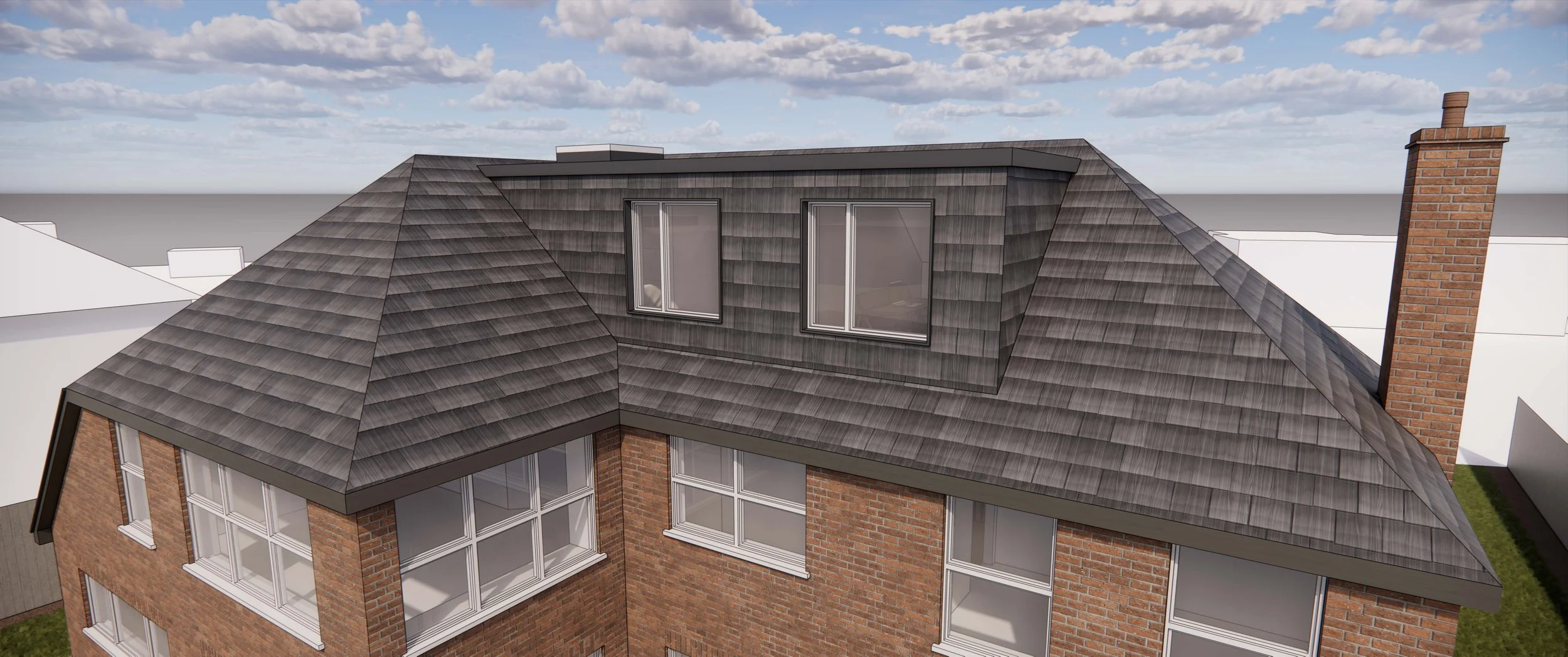
pproved and built… Permitted Development Loft Conversion in Surrey.
Following on from our outbuilding case study, "do I need planning permission for a loft conversion" is probably the second most common question we get from homeowners. The honest answer is: it depends almost entirely on the shape of the roof you're proposing, not just the room underneath it.
Loft Conversion Permitted Development Rules Explained
Most houses can extend into the loft under permitted development (PD) rights, subject to a set of fairly specific conditions:
A volume allowance of 40 cubic metres of additional roof space for terraced houses, and 50 cubic metres for detached and semi-detached houses.
No extension beyond the plane of the existing roof slope on any wall fronting a highway.
Materials that are similar in appearance to the existing house.
No verandas, balconies, or raised platforms.
Side-facing windows must be obscure-glazed and either non-opening or set 1.7 metres above floor level.
Roof extensions, other than hip-to-gable alterations, must be set back at least 20cm from the original eaves.
Within those limits, most straightforward rear dormer loft conversions can proceed under PD, which is why they're such a popular first step for homeowners wanting more space without the time and uncertainty of a full application.
Case Study: A Permitted Development Loft Conversion in Hampshire
A recent project for us involved a 1930s detached house in Surrey with a restrictive roof pitch that left very little usable headroom. Our clients wanted a proper double bedroom and en-suite, not just a glorified storage loft, which meant maximising volume right up against the PD allowance.
We modelled the roof carefully to confirm the 50 cubic metre allowance for a semi-detached property, designed a rear dormer that stayed within the eaves set-back requirement, and used rooflights rather than additional dormer windows on the side elevation to avoid the obscure-glazing restrictions altogether. The result added a full extra bedroom and bathroom without a single planning application, and construction started within weeks of the structural design being finalised.
When Do You Need Full Planning Permission for a Loft Conversion?
PD rights for loft conversions stop applying, and a full application becomes necessary, in a number of common situations:
The house is in a conservation area or is listed. PD rights for roof alterations don't apply, and any visible change needs planning permission, or Listed Building Consent, or often both.
The property is a flat or maisonette. PD rights for loft extensions apply only to houses, not flats.
The roof extension would face a highway and break the existing roof plane, which is not permitted under the relevant PD class regardless of volume.
The cumulative volume allowance has already been used by a previous rear extension or earlier loft conversion. PD volume is measured against what's already been added to the original house, not just the current proposal.
The client wants a hip-to-gable conversion that goes further than the specific permitted parameters for that alteration.
Common Mistakes With Loft Conversion Planning
The most common mistake we see isn't ambition, it's assuming the cubic metre allowance resets with every project. If a previous owner has already extended the roof, or added a rear extension that ate into the volume calculation, that allowance may already be partially or fully used. It's always worth checking the planning history of the house, not just the current roofline, before assuming a straightforward PD route is available.
FAQs: Loft Conversions and Permitted Development
Do I need planning permission for a loft conversion? Not always. Many rear dormer loft conversions on houses (not flats) fall within permitted development, provided they stay within the volume allowance and design conditions. Conservation areas, listed buildings, and flats usually need a full application.
How big can a loft conversion be without planning permission? Up to 40 cubic metres of additional roof space for terraced houses, and up to 50 cubic metres for semi-detached and detached houses, under current permitted development rules.
Can I add a dormer window without planning permission? Often yes, provided it doesn't face a highway, stays within the volume allowance, and is set back at least 20cm from the original eaves. Side-facing windows must also be obscure-glazed.
Key Takeaways
Done well, a loft conversion is one of the most cost-effective ways to add genuine living space to a house. Done without checking the numbers first, it's one of the easiest ways to end up needing a retrospective planning application halfway through a build.
Considering a loft conversion in Berkshire, Buckinghamshire, Hampshire, South Oxfordshire, Surrey, or West London? Get in touch to find out what's possible on your roof.
Extending a Listed Building: What's Possible and What's Not?
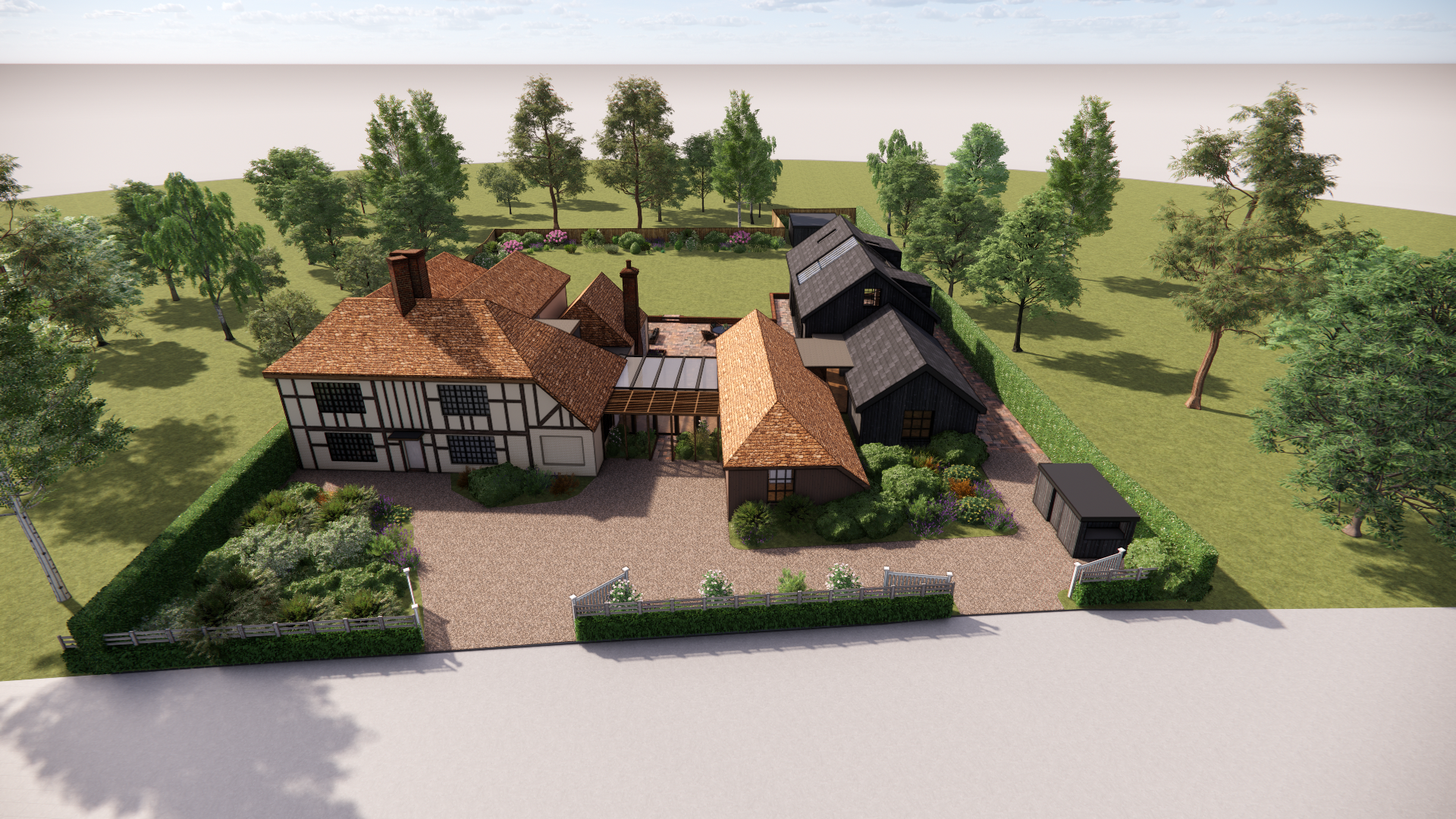
An approved Glazed Link and Dual Barns to a Grade II Listed Dwelling in South Oxfrodshire, currently under construction.
With Grade Listed Buildings, one of the questions I'm asked most often, usually within the first five minutes of a phone call, is some version of: ‘Can we even touch it?’… Owning a listed building comes with a particular kind of anxiety. People love the character of their home, but they're often convinced that any change… a new window, an extra bedroom, a kitchen extension… is somehow off-limits. It rarely is. It just has to be done properly, with the right architect and the right approach to Listed Building Consent.
A recent project in South Oxfordshire is a good example. Our clients had bought a Grade II listed farmhouse with a cramped, single-storey 1970s kitchen extension tacked onto the rear… itself not original, and not particularly sympathetic to the house. They wanted more space, more light, and a kitchen that actually worked for a family of five, but they were nervous about starting a fight with the conservation officer before they'd even had their morning coffee.
What Is Listed Building Consent?
Listed Building Consent (LBC) isn't really about whether you're allowed to extend a listed building. It's about whether the proposed work would harm the "special architectural or historic interest" of the property. In practice, that means the conservation officer is looking closely at:
Which parts of the building are original and which have been altered over the years (a 1970s extension carries far less weight than the Georgian front elevation it's attached to).
Whether new work is clearly subordinate to the historic fabric, in scale, position, and materials.
Whether the change is reversible. Extensions and alterations that could, in theory, be removed in future without damaging historic fabric are looked on far more favourably than ones that aren't.
Internal features as much as external ones… fireplaces, staircases, panelling, and joinery can all carry listing significance, even in rooms that look unremarkable at first glance.
Case Study: Extending a Listed Farmhouse in South Oxfordshire
Because the existing rear extension had no historic value, removing it was straightforward to justify. The harder conversation was about what replaced it. We designed a new single-storey kitchen and garden room in brick and oak-framed glazing, deliberately set back from the corners of the original house and finished in a contrasting but complementary palette, so that from the garden it reads clearly as a modern addition rather than a pastiche extension pretending to be old.
We also did the legwork before submitting: an early conversation with the conservation officer, a heritage statement explaining the significance of each part of the building and why our approach respected it, and photographs showing exactly what was original and what wasn't. Consent was granted without amendments, which is rarer than you'd think.
Common Mistakes Homeowners Make With Listed Building Extensions
Assuming the whole building is equally protected. It isn't… significance varies room by room, sometimes wall by wall.
Thinking "matching" is always the safest design approach. Conservation officers often prefer an honest, well-detailed contrast over a poor copy of historic detailing.
Leaving the heritage statement as an afterthought. A clear, well-argued statement is often what turns a borderline application into an approved one.
Forgetting that internal alterations need consent too, not just the visible exterior changes.
FAQs: Extending a Listed Building
Do I need planning permission as well as Listed Building Consent? Often, yes. Most extensions to listed buildings need both Listed Building Consent and full planning permission, since they're assessed against different policy tests.
Can I make internal changes without consent? No. Internal alterations to a listed building… removing a wall, replacing a staircase, even some redecoration in significant rooms… can require Listed Building Consent even if nothing changes on the outside.
How long does Listed Building Consent take? Most local authorities aim to determine applications within 8 weeks, though more sensitive heritage cases can take longer, especially where Historic England is consulted.
Key Takeaways
Listed buildings aren't meant to be frozen in time, and most conservation officers know that better than anyone. The goal isn't to avoid change, it's to make sure any change earns its place. With the right argument and the right detailing, that farmhouse kitchen is now exactly what our clients wanted: bright, modern, and built around a family's daily life, sitting comfortably alongside two hundred years of history next door.
Thinking about extending a listed building in Berkshire, Buckinghamshire, Hampshire, South Oxfordshire, Surrey, or West London? Get in touch to talk through what's possible.
Becoming a RIBA Chartered Practice and What It Means for Our Clients

BLOG POST THREE: Becoming a RIBA Chartered Practice and What It Means for Our Clients
I’m pleased to announce that Pont + Wils Architects is now a RIBA Chartered Practice, marking a milestone after five years of delivering architectural projects across Berkshire, Buckinghamshire, Hampshire, South Oxfordshire, Surrey, and West London. This achievement is more than a recognition of our work; it offers tangible benefits for homeowners and developers seeking a trusted architect for their projects.
Becoming a RIBA Chartered Practice requires meeting the highest standards of professionalism, client care, and competence. It involves ongoing professional development, rigorous quality management, ethical practice, and clear communication. For clients, this guarantees that projects; from the first concept sketch to completion; are handled by qualified, accountable professionals.
In addition, I am registered with the Architects Registration Board (ARB), the statutory regulator for architects in the UK. Only ARB-registered architects can legally use the title “architect,” ensuring that clients engage a professional who has the necessary qualifications, professional standards, and insurance.
Working with a RIBA Chartered Practice and ARB-registered architect provides clear advantages:
Commitment to quality: Projects are designed and delivered to nationally recognised standards.
Professional accountability: Clear codes of conduct ensure reliable advice, documentation, and decision-making.
Up-to-date expertise: Continuous professional development keeps our knowledge of planning, sustainability, and building regulations current.
Better project outcomes: From planning policy to consultant coordination, an architect can prevent costly mistakes and optimise design potential.
Client protection and transparency: RIBA and ARB frameworks ensure clear appointments, realistic expectations, and transparent fees.
Choosing a RIBA Chartered Practice is about more than a badge—it’s about placing your project in skilled, professional hands, ensuring a smoother, more enjoyable, and successful architectural process.
This milestone reflects the values that have guided Pont + Wils Architects from the start: thoughtful design, careful communication, and a commitment to work that endures.
Pictured above is the old RIBA Chartered Practice Logo in Red and below is the new RIBA Chartered Practice Logo in Black and White.

Navigating Outbuilding Permitted Development: A Recent Project Case Study
BLOG POST TWO - Navigating Outbuilding Permitted Development: A Recent Project Case Study
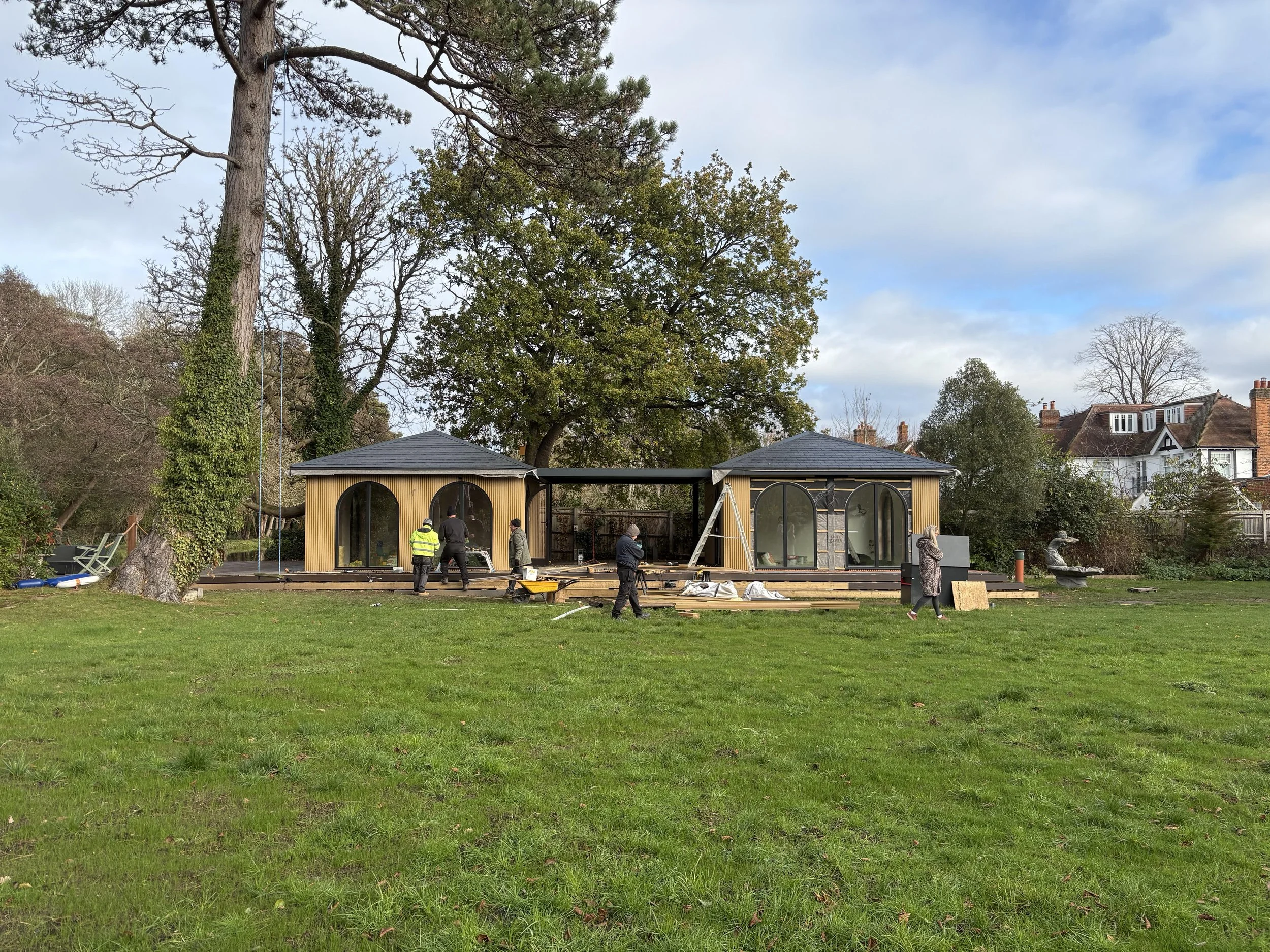
At Pont + Wils Architects, we often help homeowners in Surrey and the Home Counties create functional garden outbuildings, from home offices and studios to gyms and guest rooms. A recent project in Elmbridge demonstrates how careful permitted development (PD) planning can deliver practical outbuildings while ensuring full compliance with UK planning rules.
Our client wanted a substantial garden outbuilding with a shower room, but no kitchenette. This distinction was key, as the absence of a kitchen meant the structure would not be considered a separate dwelling, keeping it firmly within permitted development rights.
To maximise usable interior space, the outbuilding was positioned over 2 metres from the side boundary, allowing us to design it at full height under PD rules. This approach avoids height restrictions that apply to structures closer to neighbouring boundaries.
During construction, Elmbridge Borough Council were tipped off about the building. I visited the site to meet with the enforcement officer, reviewing the outbuilding against permitted development regulations and our client’s Certificate of Lawful Development for the proposed use. The officer confirmed that the building met all criteria, demonstrating how clear communication with the local authority can prevent enforcement issues.
Permitted Development Rules for Garden Outbuildings
Homeowners should be aware of the following key PD rules in England:
Single-storey only, with a maximum height of 4 metres for dual-pitched roofs or 3 metres for other roof types.
Maximum eaves height of 2.5 metres if within 2 metres of a boundary.
No kitchen allowed, ensuring the building is not treated as a separate dwelling.
Total footprint must not exceed 50% of the garden (excluding the original house).
By carefully following these guidelines, we delivered a lawful garden outbuilding with a shower room that maximised usability without triggering a full planning application.
This Elmbridge project highlights the importance of permitted development compliance, boundary-aware design, and proactive engagement with the local planning authority. It’s a clear example of how homeowners can achieve functional, stylish, and fully lawful garden outbuildings in Surrey with the right architectural guidance.
Entering Our Fifth Year in Architecture Practice

BLOG POST ONE - Entering Our Fifth Year in Architecture Practice
Starting this journal feels a little like opening a new sketchbook: full of possibility, intention and quiet excitement. Over the past five years of architectural practice, so much of my work has happened behind the scenes, evolving through countless sketches, 3D models, site visits and planning conversations long before a project ever reaches construction. This journal is my way of bringing some of that journey into the open.
At Pont + Wils Architects, our projects across Berkshire, Buckinghamshire, Hampshire, South Oxfordshire, Surrey and West London have continued to grow in scale and variety. From working carefully with listed buildings to designing contemporary extensions, replacement dwellings and small multi-unit schemes, each project carries its own narrative. These are exactly the kinds of architectural services that many homeowners and developers search for, and my aim is for this journal to become a helpful and authentic resource.
Rather than focusing solely on polished finished images, I want to share more of the thinking behind our work. This will hopefully include:
how and why certain design decisions are made on certain projects,
insights from planning applications and listed building consent processes,
reflections on materials, sustainability and detailing,
examples of design approaches for extensions and new build homes,
and the occasional story from site meetings, surveys or early client conversations.
Architecture is about far more than drawings. It is about understanding people, responding to context and creating places that feel considered and enduring. My hope is that this journal will offer future clients, homeowners and curious readers a clearer sense of how we approach design and what it is like to work with an architect.
So here is the first entry. A simple beginning that sets the tone for a collection of thoughts, lessons and experiences gathered over five years of practice.
More to come soon.